
Andrews County Bench Warrants Explained
A bench warrant is a court’s process after someone misses a required appearance or fails to follow an order. In Andrews, the exact label depends on the court and case. The city Municipal Court lists missed dates, unpaid fines, defaulted payment arrangements, unfinished court-ordered courses, probation revocation, and community-service noncompliance among its triggers.
County JP, County Court, and District Court matters have separate files and procedures. Contact the court that set the obligation rather than assuming every missed date appears in a Sheriff search.
Andrews County VPTA, FTA and Capias Terms
Andrews Municipal Court’s public warrant page separates three city labels. VPTA describes a missed response to a traffic citation. FTA refers to failure to appear on a filed Class C complaint. “Capias Profine” is the city page’s spelling for failure to honor a payout agreement. The labels are useful clues, but the clerk must confirm which one appears in a particular case.
A capias pro fine is not the same as a new probable-cause arrest warrant. Texas Chapter 45A governs justice and municipal court procedures; do not assume a city label applies to a JP, County Court, or felony case.
See the Andrews Municipal Court warrant page for its local wording.
How Andrews County Bench Warrants Are Issued
The court sets the date or condition, records whether it was met, and may issue a bench or capias process after the required steps. The court clerk can identify the case and process type. No Andrews public warrant-status code list or consolidated bench-warrant search was located.
After issuance, a Sheriff or constable may receive the process for service. A city citation may also be reported to DPS for FTA/FTP compliance, but that state reporting layer is not a warrant database.
The court’s order and later docket entries control the record. A missed date alone does not tell a reader whether process issued, whether it was served, or whether a later judge recalled it. Ask the clerk to check those events rather than relying on a general label.
After a return is filed, the docket may still show a future appearance or payment obligation. Ask whether the judge entered a recall order and whether the clerk has posted it to the case. A verbal payment confirmation does not answer every question about a separate court condition.
Andrews County’s Ten-Day Warrant Trigger
The Andrews Municipal Court says a person who signs a citation promises to appear no later than the tenth day, with the next business day used when the deadline falls on a weekend or holiday. Failure to respond can become a separate offense and may lead to a warrant. This is city-court guidance, not a rule to apply to every JP or county setting.
If the date has passed, call the Municipal Court before making a payment or appearing. Ask whether the matter is still a citation, VPTA, FTA, capias pro fine, or another status and what options the judge allows.
Keep the citation and any mailed notice together. If the paper names another court or precinct, follow that court’s response deadline instead of using the city’s ten-day instruction. A clerk can explain the docket, but a lawyer can advise about a disputed charge or possible arrest exposure.
Bench Warrants and Arrest Warrants Compared
A bench warrant is tied to a missed court duty in an existing case. An arrest warrant follows a probable-cause complaint about an offense. They can involve different records and different court instructions. Read the court and cause information before deciding which office to call. The separate Andrews County arrest warrant search explains felony and magistrate routes.
| Feature | Bench Warrant | Arrest Warrant |
|---|---|---|
| Trigger | Missed setting or court order | Probable cause of an offense |
| Who issues it | Judge in the court handling the case | Magistrate on complaint or affidavit |
| Underlying record | Existing citation or case | Complaint or charge |
| Next step | Ask about appearance, recall, payment, or hearing | Confirm court, counsel, and bond instructions |
The court label matters because a bench process is tied to an existing obligation, while an arrest warrant stems from a complaint and probable-cause review. A county Sheriff may serve either type, but the issuing court keeps the case record and determines what action will change it.
A missed appearance can lead to consequences in the pending case without creating a new criminal accusation. Ask whether the court expects a reset, an appearance, or a motion, and do not assume the arrest-warrant process is the right route simply because an officer may serve the order.
Andrews County Capias Pro Fine Resolution
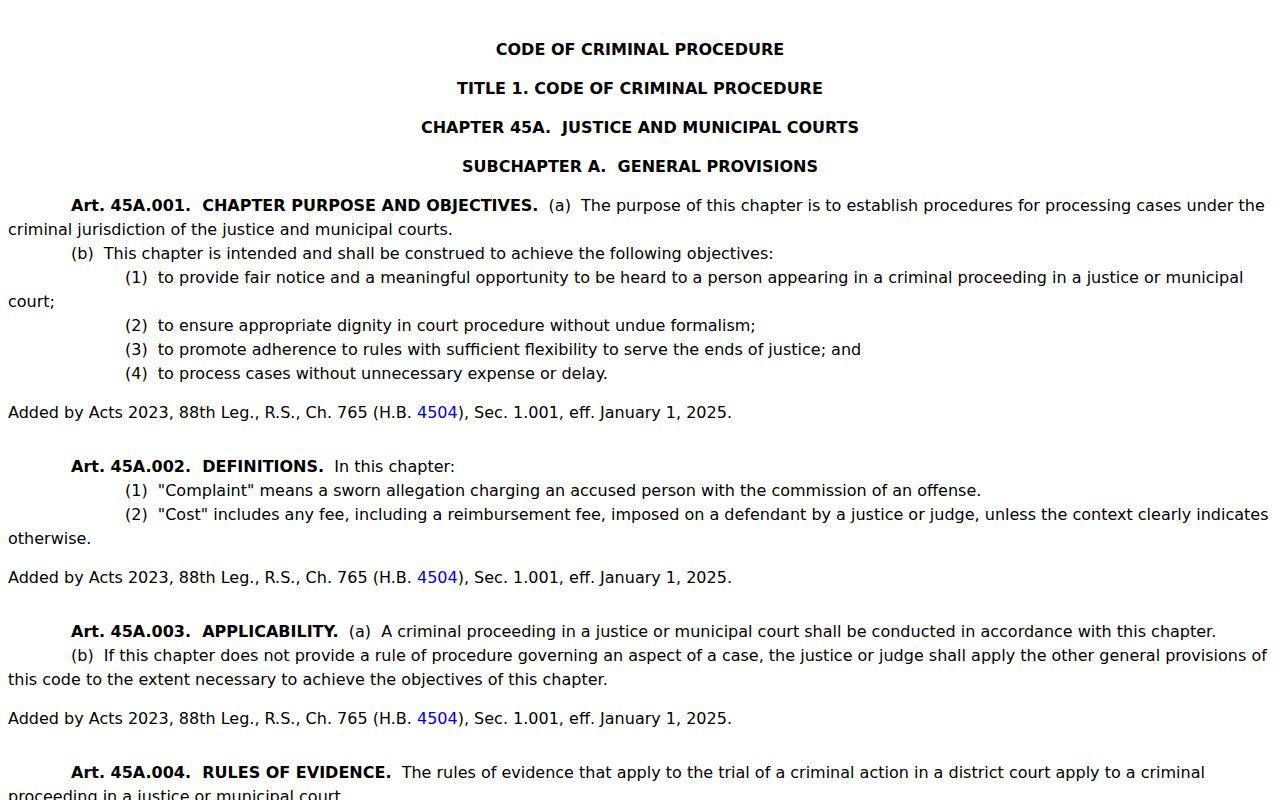
Texas Chapter 45A describes a voluntary-appearance path for a capias pro fine. Under the stated conditions, notice and a hearing or a voluntary appearance with a good-faith effort to resolve the matter can require recall before execution. Ask the issuing court how that applies to the case; a web page cannot decide eligibility. The statutory path is tied to a capias pro fine and specific notice, appearance, and resolution conditions; it is not a blanket warrant-clearing promise. The court must determine whether those conditions fit the case and what remaining fine, court cost, or compliance step applies.
The county does not publish a single walk-in schedule or recall form for every court. The official statute is Texas Code of Criminal Procedure Chapter 45A, which covers justice and municipal criminal procedure.
For any requested payment or appearance, confirm the court’s required amount and filing method first. Andrews publishes no countywide capias recall calendar, and a city-court form should not be filed in place of a justice-court or higher-court instruction.
Check the issuing court’s instructions before traveling or relying on a particular remedy.
Resolving an Andrews County Bench Warrant
Start with the issuing clerk and ask for the current status, the underlying case, any bond or balance, and whether a hearing is required. Andrews Municipal Court has city-specific payment, plea, and hardship routes. A JP, County Court, or District Court warrant may require a different appearance, attorney, bond, or motion.
- Read the notice for the court and cause or citation number, then call that court to confirm the process.
- Ask whether the court accepts payment, a plea, hardship request, reset, bond, voluntary appearance, or attorney motion for this case.
- Confirm any required hearing, location, and appearance steps before arriving; no universal Andrews walk-in schedule was found.
- Keep the receipt or written order and ask when the court will mark the process recalled or cleared.
Caution: A payment or receipt may not recall a warrant until the issuing court approves and processes the action; confirm the status directly.
If there is an active felony or arrest warrant, use counsel to verify surrender and bond instructions before visiting an office. For a city ticket, a payment confirmation and a warrant recall are separate record updates; keep the receipt and ask the clerk what document shows the court’s action.
When the court approves a resolution, ask for the case number and the date the order will appear on the docket. If a license hold or collection account is also involved, ask which office sends that downstream update and what proof it needs.
Andrews County’s City Bond Is Not Countywide
The Municipal Court warrant page describes a $100 cash bond for an unadjudicated defendant who enters a not-guilty plea. That amount belongs to that specific city-court route. It is not a general bench-warrant bond or a schedule for JP, County Court, felony, probation, or federal cases.
Andrews has no accessible countywide bond table in the materials reviewed. Ask the issuing court whether the quoted amount is a bond, a fine balance, a warrant fee, or a total that includes other court costs.
Andrews County Has No Public Bench-Warrant List
The research did not locate a public active-bench-warrant roster from the Sheriff’s Office, justice courts, or county court. The Andrews Municipal Court Tyler search is limited to city cases; a city citation result cannot establish whether a county judge issued a separate bench warrant. This is why a record inquiry must follow the court named on the missed setting or case notice.
Call the right clerk with a citation, cause number, or hearing notice. If a search has no result, ask whether the case is in another precinct or court, whether the record is restricted, and whether there is a later setting. A missing web result does not prove that no process exists.
The county’s published Sheriff page provides a general contact and an open-records request route, not a live list of court orders. A records request can seek an existing Sheriff-held document, but the issuing clerk remains the proper source for a court’s current docket and recall order.
Accordingly, neither a no-result city lookup nor an empty jail search should be described as a countywide clearance. Use the citation, court notice, or hearing order to identify the custodian and ask that office to verify the specific process.
Finding the Court That Issued the Warrant
The right contact follows the court named on the case. Andrews Municipal Court handles City of Andrews ordinance and Class C traffic matters. JP Precincts 1/4 use 432-524-1412; Precincts 2/3 use 432-524-1413. County Court matters go to the County Clerk, and felony matters to the District Clerk and 109th District Court.
The Texas Judicial Branch explains the state trial-court levels. The District Court page lists 201 N Main, Room 201 and 432-524-1419; the JP offices are at 215 NW 1st, Suites 3 and 4.
For a broader routing map, start with Andrews County warrant records.

Court level helps identify the file, but the clerk must confirm the current process.